Chinese New Year Decorations and Their Meanings
Couplets on the door, an upside-down 福, red paper in the windows and a vase of blossom: here is what each decoration means and where it belongs.
Chinese New Year 2027 falls on Saturday, February 6, 2027, beginning the Year of the Fire Goat (丁未年). The traditional celebrations run for fifteen days and end with the Lantern Festival on Saturday, February 20, 2027.
Chinese New Year 2027: dates, greetings and customsAbout the Goat
Published

When Do Chinese New Year Decorations Go Up?
Decorations go up at the very end of the old year, after the house has been cleaned. Most accounts put the hanging on New Year's Eve or the night before the holiday starts. The cleaning is part of the custom, not just housekeeping. National Geographic's education team describes a deep clean before the holiday that symbolizes ridding the household of the previous year's bad luck[1]. Columbia University's Asia for Educators notes that the old agrarian calendar names the 20th day of the 12th lunar month as the "day for sweeping floors", and that the date still marks the start of the big pre-holiday cleaning in Hong Kong[2]. A Cantonese saying puts the scrubbing on the 28th day of the 12th month: "Wash away the dirt on nin ya baat"[3].
Columbia says the new door gods, the duilian (door couplets) and any other festive decor are hung on New Year's Eve, ready for the Kitchen God's return from heaven on New Year's Day[2]. National Geographic says people decorate with red lanterns or paper couplets the night before the holiday starts[1]. In practice that means finishing everything by New Year's Eve. Once the year turns, the brooms go away: tradition holds that they are stored on the first day so the newly arrived good luck is not swept out[1]. For the exact dates of the coming festival, see Chinese New Year 2027.
Spring Couplets (Chunlian)
Spring couplets are two matching lines of verse pasted on either side of the front door, usually with a short phrase running across the top. They carry wishes for the year ahead. Wikipedia describes chunlian (春聯) as a couplet, or duilian, of typically seven characters per line, hung on either side of the door frame, with a horizontal scroll of four to five characters on the crosspiece[4]. Columbia's account adds that the couplets were written on vertical paper banners and would express wishes for good fortune, long life and many friends[2].
CGTN, China's state broadcaster, sets out the rules: each line must have the same number of characters, and the second must mirror the first in grammar and imagery[5]. Its example is 春来千枝秀 / 冬去万木苏, "Spring comes, 1,000 branches bloom / Winter goes, 10,000 trees revive"[5]. Which line goes on which side depends on the horizontal phrase: when it is written from right to left, the first vertical line goes on the right too, and the second on the left[5].
The form is old. Wikipedia traces fai chun, the Cantonese name, to taofu (桃符; peach wood charms) hung at doors in ancient times[4]. A related decoration is the doufang (斗方), a single character written on a square turned so its corners point to the four cardinal directions; 滿 man is stuck on rice bins or refrigerators as a wish for abundant food[4]. For phrases to say out loud rather than paste up, see our guide to New Year greetings, and for the story of how the festival grew, the history of Chinese New Year.
Why Is 福 Hung Upside Down?
The character 福 stands for fortune and happiness, and many families hang it upside down on purpose. The reason is a pun: the Chinese word for upside down sounds like the word for arrive, so an inverted 福 reads as good luck arriving at the door. The Confucius Institute for Scotland explains that 倒 (dào, "upside-down") and 到 (dào, "arrive") sound alike, so 福倒了 (fú dào le) sounds the same as 福到了, "good luck is arriving"[6]. Wikipedia notes the two words are homophones in nearly all varieties of Chinese, and that mounting the character at entrances dates to at least the Song dynasty (960 to 1279 CE)[7].
The sources disagree on whether it is always inverted. Wikipedia's chunlian article says 福 is "always purposely posted inverted" and usually hung on the center of the front door[4]. CGTN says it is usually pasted in the center of the three couplet lines in an upright position, and that some people like to turn it upside down for the pun[5]. The fair summary is that it is often, not always, hung upside down. Traditionally the character is written on square red rice paper with a calligraphy brush[6].
Paper Cuts on Windows and Doors
Red paper cuts stuck on windows and doors are one of the plainest signs that a household is ready for the New Year. China Daily describes sticking paper-cut decorations on windows and doors, and hanging lanterns, as a Spring Festival tradition meant to usher in blessings, with the all-red effect creating a joyful atmosphere for family gatherings[8]. The paper cuts made for windows are called "window flowers" (窗花; chuāng huā)[9].
Window cuts are tied to the start of spring. Wikipedia says that in many areas of China, especially in the north, paper-cuttings are pasted to windows to welcome spring, a tradition practiced since the Song and Yuan dynasties[9]. UNESCO, which lists Chinese paper-cut as intangible cultural heritage, describes it as a predominantly female pursuit passed from mother to daughter, with styles that vary by region (in southern China, fine and delicate motifs predominate) and uses that include interior decor for windows, beds and ceilings[10].
If you want to make your own, start with our paper-cut templates, and for ready-made pieces to print and hang, see the printable decorations.
Door Gods
Door gods are a pair of painted or printed guardian figures pasted on the two leaves of a front door, one on each side, to keep evil spirits out of the house. They are bought new for the New Year and put up with the couplets. Columbia notes that likenesses of door gods were affixed to the front gate to guard against evil spirits or ghosts[2]. Wikipedia says that in modern use they are usually printed images pasted to paired doors and usually replaced every Chinese New Year[11].
How they are placed matters. The Ashmolean Museum in Oxford explains that door gods always come in pairs and are pasted facing each other, since placing them back to back is considered bad luck, and that they face the visitor who is entering the house[12]. The most familiar pair are two generals: Yuchi Gong has a darker face and holds a steel whip or batons, while Qin Qiong has a pale face and carries swords[12]. Not all door gods are warriors. Wikipedia describes a separate class of civil door gods, scholars meant to attract blessings and good fortune[11], and the Metropolitan Museum of Art holds a Republic-period (1912 to 1949) print titled "New Year Picture of Paired Civil Door Gods with Five Children"[13].
China Daily, reporting on a Palace Museum exhibition, says couplets and images of door gods are hung on the gates of the Forbidden City to wish for prosperity and ward off evil spirits[14]. One detail differs from most homes: many couplets in the palace are written on white paper, unlike the red ones most visitors would have at home[14].
New Year Pictures (Nianhua)
New Year pictures are bright printed images, often of gods, children or lucky scenes, that families pasted up outside and inside the house at the New Year to protect the home and bring good fortune. Door gods are one kind; the Kitchen God portrait above the stove is another. The Ashmolean says such images would be kept in place and worshipped during the whole year to protect the home from evil spirits and bring good fortune[12]. Wikipedia, by contrast, says that as each New Year arrives every family replaces its New Year picture to "say goodbye to the Past and welcome the Future" (辞旧迎新)[15]. Both can be true at once: the picture stays up all year, then gives way to a new one.
The kitchen has its own cycle. The Ashmolean describes the preparations starting with sending the Stove God off to Heaven on the 23rd day of the last month, with a new image installed above the stove seven days after the old one was burned[12]. Columbia likewise has the new Kitchen God portrait hung on New Year's Eve[2]. The best-known printing towns include Yangliuqing (Tianjin), Yangjiabu (Shandong), Wuqiang (Hebei), Fengxiang (Shaanxi), Taohuawu (Suzhou) and Mianzhu (Sichuan), with Yangliuqing widely regarded as the most influential[15]. The Ashmolean quotes the old pairing "Taohuawu in the South and Yangliuqing in the North"[12].
Red Lanterns and the Color Red
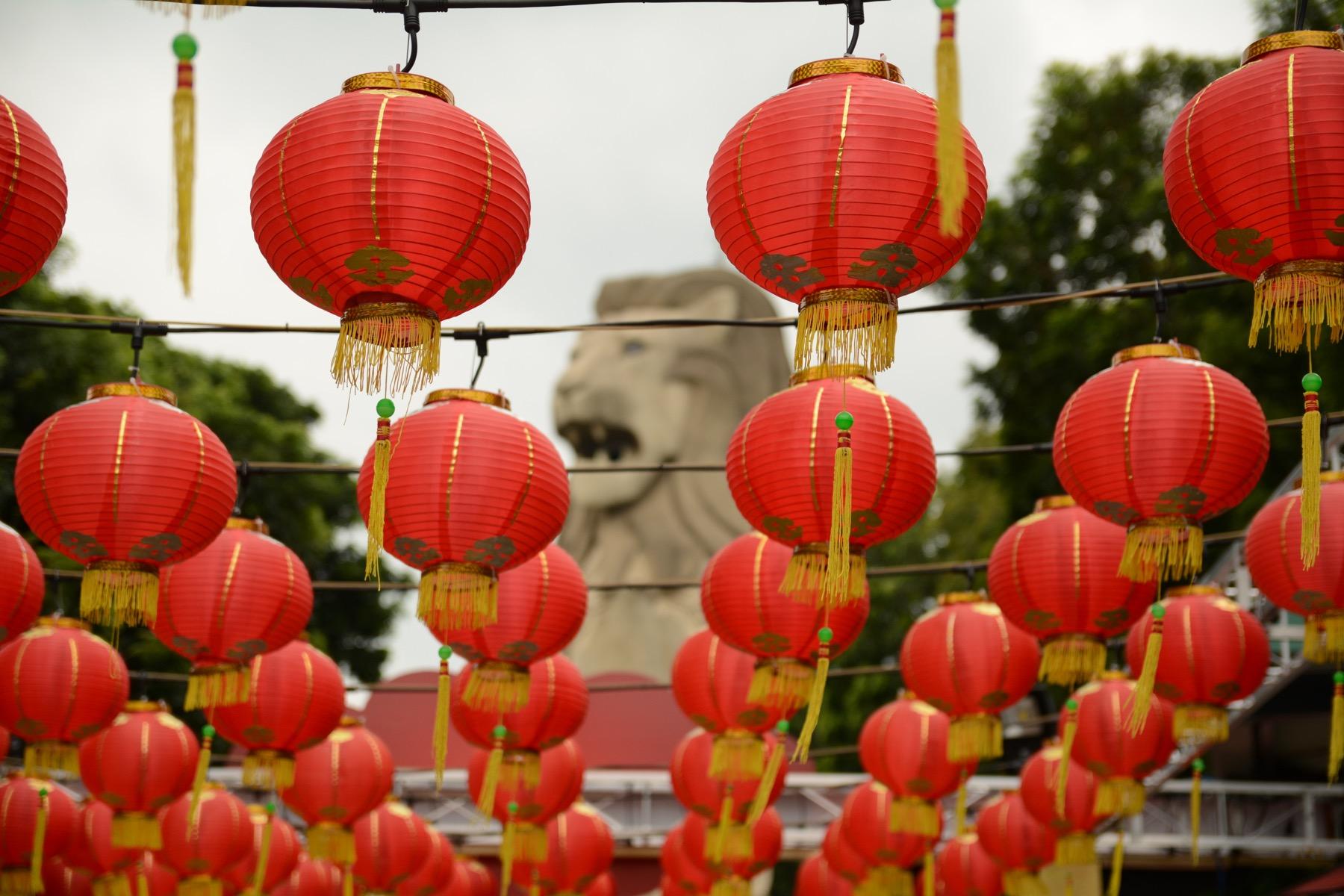
Red lanterns belong to the New Year look as much as couplets do, and red runs through almost every other decoration on this page, from couplets to paper cuts. National Geographic says people decorate with red lanterns or paper couplets the night before the holiday starts, and that red is the color of joy and good fortune in Chinese cultures[1]. China Daily pairs hanging lanterns with paper cuts as a way to usher in blessings[8], and in the Forbidden City the eaves are decorated with lanterns in line with imperial tradition[14].
Many Lunar New Year customs are believed to come from the legend of the Nian monster, a creature said to terrorize villagers on the last day of the lunar year; the Library of Congress notes that people still wear red clothing and display red decorations today[16]. We found no reliable source on how many lanterns to hang or which side of the door they belong on. The lanterns that do have a firm date are the ones of the Lantern Festival on the 15th day, which comes with its own lantern riddles.
Flowers, Fruit and Plants
Flowers and fruit trees are decorations too, chosen because their names or their look carry a wish for the year: blossom for growth, citrus for gold and good fortune. Peach blossom, narcissus and potted kumquats are the classic choices, especially in southern China and Hong Kong. Columbia notes that flowers are a popular market item at this time of year, with wax plum, fragrant white jonquils or narcissus, and in Hong Kong small peach trees among the seasonal favorites[2]. The Asian Art Museum in San Francisco explains what each one means in its brochure on fruits and flowers for the New Year[17]:
- Peach or plum blossom
- Southern Chinese families display a blossoming peach or plum tree at home during the New Year, kept in the oldest and nicest porcelain vase, since it is believed that the older the vase, the longer the flowers will bloom[17].
- Narcissus
- Known as the Water Fairy Flower, it is a symbol of good fortune and prosperity, and bulbs from Zhangzhou, Fujian, are considered the best[17].
- Kumquat
- Pronounced Gumgut in Cantonese, the name is a pun for gold (gum) and for good fortune (dai gut)[17].
- Mandarin oranges
- At the New Year a pair of mandarin oranges, together with red envelopes of money, is placed next to the pillow of every child in the family[17].
- Pussy willow
- Since the Chinese like numerous blossoms on a branch, the willow's many buds make it a favorite New Year flower[17].
New Year Flower Markets
In Hong Kong, the place to buy all of this is the Lunar New Year fair, a week of markets that runs up to New Year's Eve and closes in the early hours of New Year's Day. The Hong Kong government says the fairs let the public buy festive plants and flowers, New Year food, decorations and spring couplets (fai chun)[18]. In 2026 they ran at 14 locations for seven days from February 11, closed at 7am on February 17, and drew about 2.65 million visitors; the busiest day was New Year's Eve, February 16, with more than 210,000 people at Victoria Park alone[19].
Victoria Park is Hong Kong's largest flower market, with around 400 stalls, and a stallholder there told China Daily that kumquats laden with fruit signify good fortune and great profit, while peach blossoms symbolize grand ambitions and good relationships[20]. One shopper interviewed by The Standard planned to buy peach blossoms and narcissus as usual, and another stressed buying early for the best blossoms[21]. The 2027 fair dates had not been published when we checked. Customs differ from place to place; our page on regional variations covers more of them.
Where Each Decoration Goes in the Home
Most decorations belong at the front door, where visitors and good luck are expected to arrive, with a few placed in the kitchen, on windows and beside food stores. Here is where the sources put each one, though families vary. Beyond the items below, we found no sourced rule for where a given decoration must go.
- Front door, either side
- The two lines of the spring couplet, with the horizontal phrase above the door[2].
- Front door, center
- The 福 character, usually on the center of the front door[4].
- Door leaves
- Door gods in a pair, facing each other and facing whoever comes in[12].
- Windows
- Paper cuts, the "window flowers"[9]; UNESCO also lists beds and ceilings among the places paper-cuts decorate[10].
- Kitchen
- A new image of the Stove God above the stove[12].
- Rice bin or refrigerator
- The single character 滿, a wish for abundant food[4].
- Behind the doors
- Some southern families place stalks of sugar cane behind the doors[2].
- A child's pillow
- A pair of mandarin oranges with red envelopes[17].
When Do the Decorations Come Down?
No source we trust names a day for taking New Year decorations down, so be wary of any page that gives one with confidence. The nearest fixed point is the Lantern Festival on the 15th day, which closes the New Year season, and some printed decorations are meant to stay up all year. Columbia says the Lantern Festival signals the end of the New Year festival period[2], and Wikipedia calls it the final day of the traditional celebrations[22]. Day-by-day customs up to then are on our fifteen days of Chinese New Year page.
For door gods and New Year pictures, the sources point the other way: they are kept in place through the year and replaced when the next New Year comes round[12][11]. In the older practice the Ashmolean describes, paper gods were given offerings on New Year's Day and later burned[12]. For everything else, from lanterns to window cuts, the choice is a household one. For the wider picture, see our overview of New Year traditions.
Questions and Answers
What are the traditional Chinese New Year decorations?+
Why is the 福 character upside down?+
Source: Confucius Institute for Scotland, "The Arrival of 福" (2021), CGTN, "Chunlian 101: The essential Spring Festival decoration in China" (2021)
When should I put up Chinese New Year decorations?+
Source: Columbia University, Asia for Educators, "The Lunar New Year: Rituals and Legends", National Geographic Education — "Lunar New Year"
When do you take Chinese New Year decorations down?+
Source: Columbia University, Asia for Educators, "The Lunar New Year: Rituals and Legends", Wikipedia, "Door god"
Which side does the first line of a spring couplet go on?+
Source: CGTN, "Chunlian 101: The essential Spring Festival decoration in China" (2021)
Explore the Zodiac Year
Sources & References
- National Geographic Education — "Lunar New Year"
- Columbia University, Asia for Educators, "The Lunar New Year: Rituals and Legends"
- Wikipedia — "Chinese New Year" (clothing and gift customs)
- Wikipedia, "Chunlian"
- CGTN, "Chunlian 101: The essential Spring Festival decoration in China" (2021)
- Confucius Institute for Scotland, "The Arrival of 福" (2021)
- Wikipedia, "Fu (character)"
- China Daily, "Cutting remarks: The hidden meanings of festive decorations" (2019)
- Wikipedia, "Chinese paper cutting"
- UNESCO Intangible Cultural Heritage, "Chinese paper-cut" (2009)
- Wikipedia, "Door god"
- Ashmolean Museum, "Chinese New Year Prints - Good Fortune all year long!" (2018)
- The Metropolitan Museum of Art, "New Year Picture of Paired Civil Door Gods with Five Children" (collection record)
- China Daily, "Festival city" (2019)
- Wikipedia, "Nianhua"
- Library of Congress, "Celebrating Lunar New Year with the Library of Congress's Collections" (2024)
- Asian Art Museum, "Fruits and Flowers for the Chinese New Year" (brochure)
- Hong Kong Government, Food and Environmental Hygiene Department, Lunar New Year fairs press release (2026)
- Hong Kong Government, Food and Environmental Hygiene Department, "2026 Lunar New Year fairs concluded" press release (2026)
- China Daily, "Hong Kong's new year fairs bloom with festive spirit" (2026)
- The Standard, "Lunar New Year fairs open with cautious cheer for the Year of Horse" (2026)
- Wikipedia, "Lantern Festival"