Tangyuan
Small, round and usually sweet, these glutinous rice balls are the last dish of the New Year season, and the two names they go by describe two different ways of making them.
Chinese New Year 2027 falls on Saturday, February 6, 2027, beginning the Year of the Fire Goat (丁未年). The traditional celebrations run for fifteen days and end with the Lantern Festival on Saturday, February 20, 2027.
Chinese New Year 2027: dates, greetings and customsAbout the Goat
Published

Why a Bowl of Rice Balls Closes the Holiday
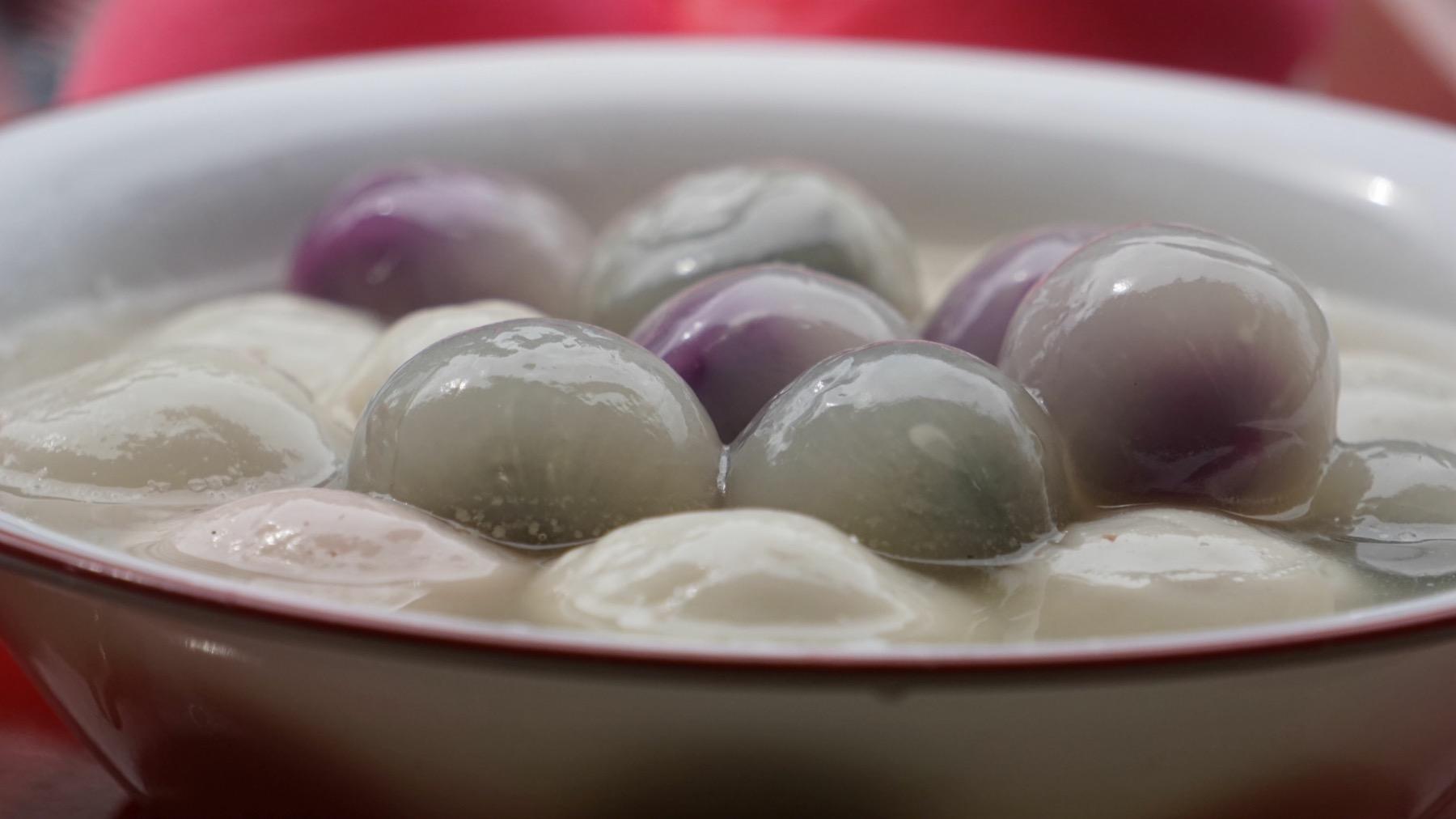
Tangyuan are balls of glutinous rice, most often wrapped around a sweet filling, and they end the New Year season for a simple reason: their name sounds like tuanyuan, the word for a family reunion. Xinhua reports that this is why they became a symbolic food for family meals as the Spring Festival draws to a close[1].
The shape repeats the message. China Daily writes that the round shape stands for family unity, completeness and happiness[2], and the China Heritage project at the Australian National University reads the massing of the balls in one bowl as completion, togetherness and harmony[3]. The historian Luo Shuwei said in 2026 that they are more than just food: they represent reunion[4]. Wikipedia lists sweet rice balls among traditional New Year foods and says they symbolize family togetherness[5].
Their main night is the Lantern Festival, the first full moon of the lunar year, which marks the official end of the celebrations[4] and falls on the last of the fifteen days.
Rolled or Wrapped: Yuanxiao and Tangyuan Are Made Differently
The two names are not simply northern and southern words for one food; they describe two ways of making it. Northern yuanxiao are built up from the filling outward, southern tangyuan are wrapped by hand, and you can taste the difference. In the north, cooks roll the filling in dry glutinous rice flour, much like building a snowball; in the south, a glutinous rice dough is wrapped around the filling, the way dumplings are made[4].
At the Beijing bakery Daoxiangcun, a chef shakes the fillings in a bamboo sieve until they turn into snowy-white yuanxiao, and as China Daily puts it, the difference is all about the process[4]. Yuanxiao, usually sweet, come out chewier, while tangyuan are softer and silkier and come in both sweet and savory versions[4]. If the wrapping sounds familiar, it is close to folding dumplings.
Fillings Change From City to City
Southern tangyuan can be sweet or savory, and several cities are known for a particular filling, from rich sesame in Zhejiang to meat and greens in Jiangsu and chicken in Guizhou. China Daily points to lard-and-sesame tangyuan from Ningbo, chicken-stuffed balls served in chicken soup from Xingyi in Guizhou, and balls filled with pork and shepherd's purse in Yangzhou[4].
These fillings are part of the regional differences in New Year food. Recipes we trust are listed below.
A Song Dynasty Custom, and a Legend About the Name
Eating sweet rice balls at the Lantern Festival goes back at least to the Song dynasty, when cooks in what is now Ningbo came up with a new filled variety, and by the last imperial dynasties the north and south had settled into separate styles. China Daily dates the first record of the custom to the Song (960 to 1279) and credits Mingzhou, today's Ningbo[6]. By the Ming and Qing dynasties (1368 to 1911), the north-south divide was firmly established[4].
The southern name has a story attached, told as legend, not history. One popular account holds that Yuan Shikai, the Republic of China president who declared himself emperor in 1916, preferred the name tangyuan because yuanxiao 元宵 sounded like 袁消, "Yuan obliterated"[3]. Wikipedia also introduces it with "legend has it"[7]. For the longer story of the festival, see our history of Chinese New Year.
Not Only on the Fifteenth Night
In southern China tangyuan are not kept for the Lantern Festival alone: they are also eaten at the winter solstice and on January 1, while northern yuanxiao usually stay a Lantern Festival food. Xinhua notes that split[1].
At Dongzhi, the winter solstice festival, families eat them together, and each family member receives at least one large ball along with several small ones[8]. Some of these are treated as protective talismans meant to keep evil spirits away from children[8]. For the 2027 date, see Chinese New Year 2027, and for the other dishes of the season, our guide to New Year foods.
Recipes We Recommend
We do not publish our own recipes. These are traditional versions by cooks with real standing in Chinese home cooking, each cooked and photographed by its author and free to read.
- Tang Yuan (Sweet Rice Balls with Black Sesame Filling) (The Woks of Life)
Judy's Woks of Life version of black sesame tang yuan for the Lantern Festival, with the filling and dough shaped step by step.
- Dad's Sweet Sesame Tong Jyun: A Chinese Chef's Secrets (Made With Lau)
Daddy Lau's family tong jyun, the Cantonese name for tang yuan, with a sesame filling and sweet ginger soup, shown on video.
- Black Sesame Tang Yuan (黑芝麻汤圆) (Wok and Kin)
Jeannette's black sesame tang yuan with a lard-and-sesame filling ground in a mortar and served in ginger syrup, photographed at each step.
Questions and Answers
What is the difference between tangyuan and yuanxiao?+
Source: China Daily, report on tangyuan and yuanxiao for the Lantern Festival (2026)
Why are tangyuan eaten at Chinese New Year?+
Source: Xinhua, "Feature: Families across China prepare sweet rice balls for Lantern Festival" (2018), China Daily, "Lantern Festival food: 'Tangyuan' or 'yuanxiao'" (2018)
When else are tangyuan eaten?+
Source: Xinhua, "Feature: Families across China prepare sweet rice balls for Lantern Festival" (2018)
How old is the custom of eating tangyuan?+
Beyond the Festivities
Sources & References
- Xinhua, "Feature: Families across China prepare sweet rice balls for Lantern Festival" (2018)
- China Daily, "Lantern Festival food: 'Tangyuan' or 'yuanxiao'" (2018)
- China Heritage (Australian Centre on China in the World, ANU), "The End of the Beginning 元宵"
- China Daily, report on tangyuan and yuanxiao for the Lantern Festival (2026)
- Wikipedia — "Chinese New Year" (clothing and gift customs)
- China Daily, "A taste of Spring Festival" (2019)
- Wikipedia, "Tangyuan (food)"
- Wikipedia, "Dongzhi Festival"